- AI Business Insights
- Posts
- Your AI is lying to you (fix inside)
Your AI is lying to you (fix inside)
5 reasons your AI keeps agreeing with you
Most people use AI like a friend who never disagrees with them. You describe your idea, it tells you it's solid, you walk away feeling smart. That's not feedback. That's a mirror with an opinion.
I caught a post on r/PromptEngineering this week with one tiny fix for that problem, and the comments lit up. Everyone was saying the same thing: how have I not been doing this the entire time?
In partnership with

The ones showing up in LLMs convert 3× better than Google

They optimized for LLMs, not just Google.
FAQs. Comparison pages. Transparent pricing. LinkedIn presence. These aren't vanity plays. They're what gets you cited in ChatGPT, Gemini, and Claude when your buyers are researching, your investors are looking, and your future hires are deciding where to work.
Download the free AEO Playbook for Startups from HubSpot and get the exact checklist. Five minutes to read.
The Yes-Machine Problem
When you describe your own idea to an AI, you're already biased. You've been living with the concept for weeks. The gaps look like features. The risks feel manageable. You stopped seeing what a stranger would catch in five seconds.
The AI doesn't help here. By default it mirrors your enthusiasm. It finds the strengths because you led with them. It softens the weaknesses because that's how it was trained: be helpful, be polite, be constructive.
Constructive feedback is great when you're already shipping. Before you ship, you don't want constructive. You want brutal.
The Prompt
Here's the exact one from the original poster:
"Here is my business plan. Act as a cynical venture capitalist. Give me 5 reasons why you would REJECT this deal."
That's the whole thing. Paste your plan above or below it, hit send, and watch the AI flip from cheerleader to assassin.
Three things make this work, and all three matter.
Role assignment. "Cynical venture capitalist" gives the model a specific skeptic to play. VCs have watched thousands of pitches die. They're trained to find the gap between what founders believe and what the market actually does. The AI now has a concrete persona with built-in domain experience to pull from.
Hard number. "5 reasons" forces it past the obvious first objection. Reasons one and two are usually things you already know. Reasons four and five are where the real problems live, the ones you've been quietly avoiding without realizing it.
Capital letters on REJECT. Yes, capitalization works on language models. It signals you want direct criticism, not diplomatic suggestions wrapped in "here are some areas to consider improving." Tiny detail. Reliably sharper output.
Payroll errors cost more than you think

While many businesses are solving problems at lightspeed, their payroll systems seem to stay stuck in the past. Deel's free Payroll Toolkit shows you what's actually changing in payroll this year, which problems hit first, and how to fix them before they cost you. Because new compliance rules, AI automation, and multi-country remote teams are all colliding at once.
Check out the free Deel Payroll Toolkit today and get a step-by-step roadmap to modernize operations, reduce manual work, and build a payroll strategy that scales with confidence.
*Ad
Where Else This Works
The same logic applies to anything you're about to commit time or money to. Swap the role, swap the asset, keep the structure.
Product feature: "Act as a frustrated user. Give me 5 reasons this feature would annoy you."
Marketing copy: "Act as a skeptical customer who's seen too many ads. Give me 5 reasons this headline would make you scroll past."
Job application: "Act as a hiring manager with 200 resumes on the desk. Give me 5 reasons you'd skip this one."
Content strategy: "Act as an editor who's read everything. Give me 5 reasons this topic doesn't need another article."
Pricing decision: "Act as a price-sensitive buyer. Give me 5 reasons this price would make me walk."
The role you pick matters more than people realize. A frustrated user and a skeptical investor will spot completely different holes in the same plan. If the stakes are high, run both. You'll get a fuller picture in 10 minutes than a week of asking friends.
How To Actually Use the Output
Some objections will be generic. A few will miss your specifics. That's fine. The point isn't a verdict. The point is forcing yourself to have clean answers ready before the real conversation happens.
If an objection stings, that's usually the one you needed to hear. Write a real response to it. Add it to your plan.
Here's the move that took this from useful to essential for me. After you write rebuttals to each rejection reason, paste them back in and ask the AI to evaluate whether your rebuttals actually hold up. You're running a pre-mortem and patching the holes before anyone else sees the plan. If your rebuttal can't satisfy the cynical VC persona, it probably won't satisfy a real VC either. Keep tightening until the answers are clean.
That's the whole loop. Five minutes of hostile feedback today saves you a month of recovering from the wrong decision next quarter.
Your Move
Take whatever you're working on right now. Plan, pitch, headline, price, application. Paste it in. Pick the most cynical version of your target audience. Ask for 5 reasons to reject it.
Then sit with the answers. The ones that hurt are the ones worth fixing.
How did you like today's issue? |
Your next great hire lives in Slack.
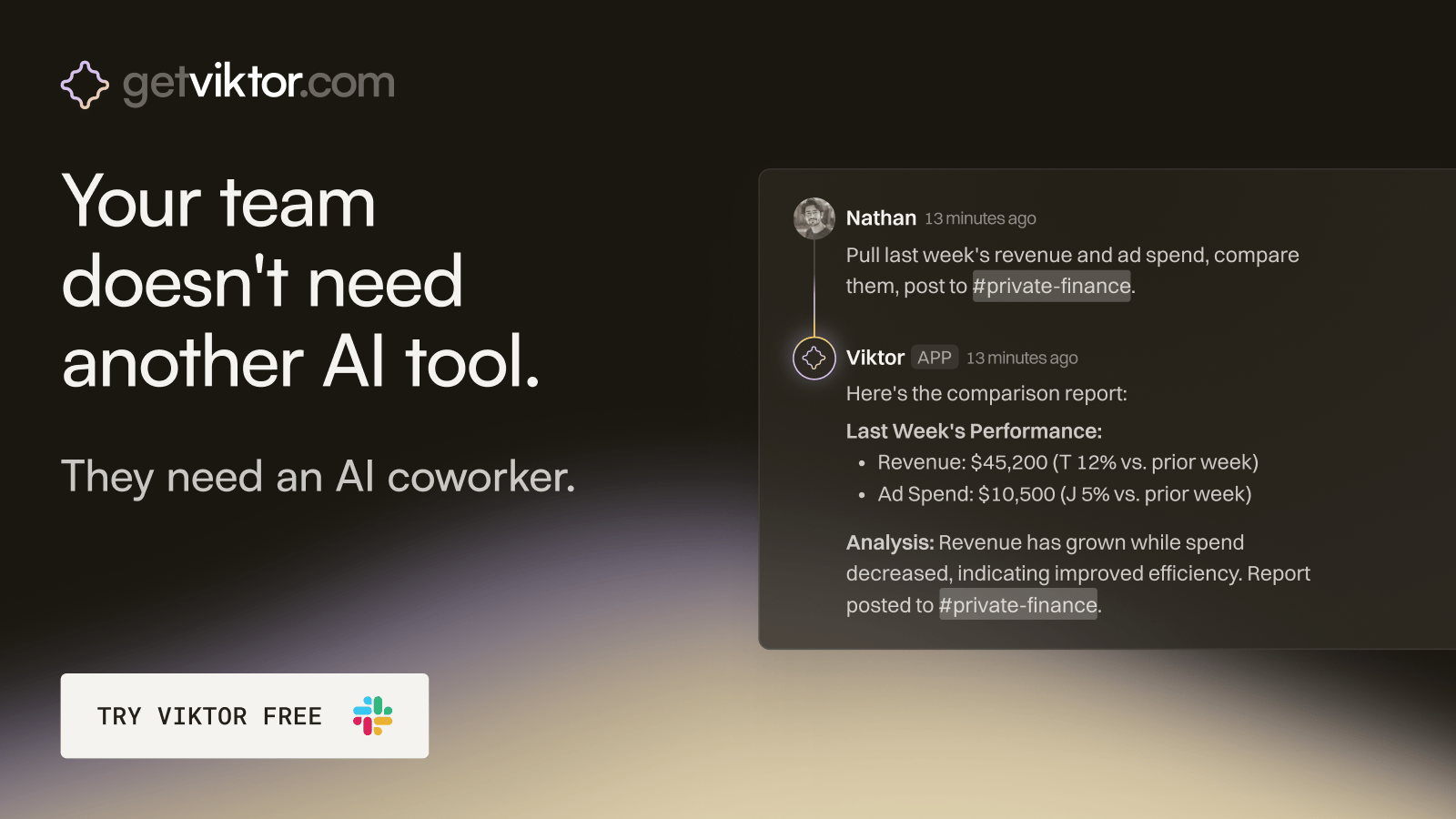
Viktor is an AI coworker that connects to your tools and ships real work. Ask Viktor to pull a report, build a client dashboard, or source 200 leads matching your ICP. Most teams hand over half their ops within a week.
*Ad