- AI Business Insights
- Posts
- Watch Your Replies Snap
Watch Your Replies Snap
Stop Guessing and Start Engineering Your Prompts
When an AI gives you a bad answer, it is usually not because the model is “stupid”; it is because your instructions were incomplete. A Reddit user shared a “Prompt Optimizer” that addresses this by turning rough ideas into clear, testable commands.
Many of us ask a quick question, get a generic reply, then spend minutes correcting format, tone, and length. The optimizer breaks that loop by acting as a filter between you and the model. It checks your draft prompt for key variables—audience, format, constraints, and tone—then rewrites it into a structured instruction the AI can follow on the first pass.
In partnership with

Shoppers are adding to cart for the holidays

Over the next year, Roku predicts that 100% of the streaming audience will see ads. For growth marketers in 2026, CTV will remain an important “safe space” as AI creates widespread disruption in the search and social channels. Plus, easier access to self-serve CTV ad buying tools and targeting options will lead to a surge in locally-targeted streaming campaigns.
Read our guide to find out why growth marketers should make sure CTV is part of their 2026 media mix.
What makes this useful is that it turns prompt engineering from trial-and-error into a repeatable process. The creator offers it for free via a web interface and as a reusable system-prompt method you can paste into your own chats. Either way, it enforces quality control before you hit enter.
The Checklist Framework
The tool works by categorizing information you assume is “obvious.” Humans rely on shared context and shorthand, but an AI does not share your history. It needs each variable stated explicitly.
The optimizer scans for pillars of communication and flags what is missing. Audience matters: explaining something to a marketing executive is different from explaining it to a software engineer. Format matters: if you want bullets, JSON, or a markdown table, you must say so or you will get a wall of text.
Constraints keep outputs on track. Word limits, forbidden terms, and style rules prevent drift. The tool either fills gaps with sensible defaults or asks you to clarify, so the final prompt is hard to misread.
The System Prompt Workflow
The web tool is convenient, but the more powerful idea is to bake the logic into a conversation using a system prompt. A system prompt is the “backstage” instruction that sets how the AI behaves before it answers.
If you start a chat by telling the AI to act as a Prompt Optimizer, you can write short, messy requests without sacrificing output quality. You instruct it to rewrite your message into a complete prompt instead of answering immediately, then wait for your confirmation. For example, “email to boss about delay” becomes a polished instruction with role, context, tone, and formatting baked in.
The framework thousands of teams use daily
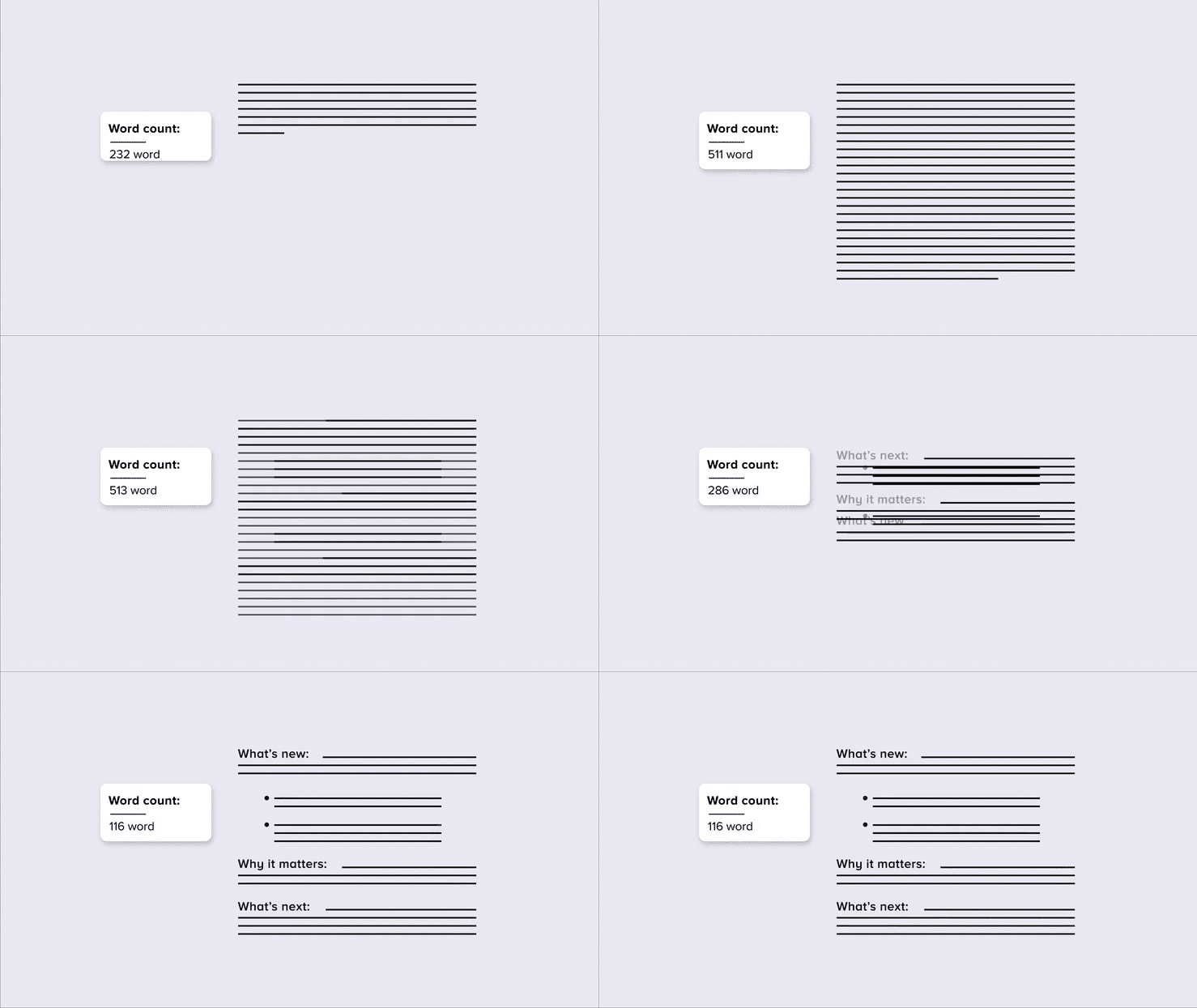
Organizations worldwide are adopting Smart Brevity to move faster with clearer comms. This free 60-minute session shows you how the methodology works and how to start applying it immediately.
*Ad
Other awesome AI guides you may enjoy
Learning Through Feedback
The optimizer is also a teaching tool. It explains what it changed and why, turning each rewrite into a quick lesson.
Most prompting is a black box: you try something, it works or fails, and you do not know the reason. Here, you might see notes like “added a persona” or “added a word-count constraint to reduce verbosity.” Over time, you start spotting missing elements yourself and need the tool less.
How to Apply This Strategy
You can use the same principles without the tool. Before sending a complex request, check for these five elements:
Role/Persona: Who is the AI acting as?
Task: What action should it take?
Context/Audience: Who is this for, and what background is required?
Format: What should the output look like (table, code, email)?
Tone: Should it be formal, witty, or concise?
If your prompt is missing any of these, you are gambling on the result.
Final Thoughts
This approach focuses on the basics of communication, not gimmicks. Better inputs reliably produce better outputs, and a simple checklist can make that repeatable.
Learn AI in 5 minutes a day

What’s the secret to staying ahead of the curve in the world of AI? Information. Luckily, you can join 1,000,000+ early adopters reading The Rundown AI — the free newsletter that makes you smarter on AI with just a 5-minute read per day.
*Ad