- AI Business Insights
- Posts
- Stop AI From “Showing Off” With This Simple Command
Stop AI From “Showing Off” With This Simple Command
When Your Prompts get Noisy
I used to think the best AI answer was the longest one. The kind that looks like a mini textbook, with ten options, five warnings, and a “just in case” appendix. Then I realized something uncomfortable, the AI was not helping me, it was performing for me. It wanted to look smart more than it wanted to be useful. And if you have ever shipped a messy solution just because it sounded “advanced,” you know how expensive that can get. This talented creator’s piece hit me because it shows a tiny command that flips the whole vibe instantly.
Most of the time, your AI isn’t giving you the best answer; it is giving you the most impressive one.
In partnership with

AI in HR? It’s happening now.

Deel's free 2026 trends report cuts through all the hype and lays out what HR teams can really expect in 2026. You’ll learn about the shifts happening now, the skill gaps you can't ignore, and resilience strategies that aren't just buzzwords. Plus you’ll get a practical toolkit that helps you implement it all without another costly and time-consuming transformation project.
We assume long equals accurate, but that is a trap, especially in technical work. In a Reddit thread, a user named AdCold1610 described debugging a messy nested loop and getting a forty-line solution from ChatGPT. The user was annoyed and typed four words, “you’re overthinking this.” The model apologized, then collapsed the whole thing into three clean lines.
The “Impress Me” Bias
AdCold1610 points out something we all feel but rarely name, models often default to “show off mode.” When you ask a technical question, the training bias leans toward comprehensive, encyclopedic responses, not the simplest fix that actually works. The output may be correct, but it is wrapped in complexity that makes you think you are getting a “premium” answer.
A perfect example from the thread was database optimization. The AI went big first, “rewrite the schema,” “add caching,” “install Redis,” the whole production-scale fantasy. After the “overthinking” nudge, the model revealed the real fix, add an index to one column. That is the punchline, the model usually knows the boring solution, it just does not lead with it unless you demand it.
The Senior Dev Syndrome
The comparison in this post is painfully accurate, ChatGPT can behave like an enthusiastic senior developer. Ask them to fix a typo, and suddenly you are in a lecture about long-term architecture, future scaling, and why the whole stack should be redesigned. Sometimes that mindset is valuable, but a lot of the time you asked for a bandage, not surgery.
This is where the danger lives. Users copy the heavy solution because it sounds authoritative, then they inherit extra maintenance, extra surface area for bugs, and extra confusion for the next person who touches the code. A small prompt that forces the AI to aim for “minimum viable correctness” can save you hours later.
Investor notes without the rewrite

Dictate meeting recaps, strategic plans, and executive summaries and get polished writing ready to paste. Wispr Flow preserves nuance and formats numbers and lists cleanly. Try Wispr Flow for founders.
*Ad
Other awesome AI guides you may enjoy
Recursive Simplification
Here is the move I like most, you can do it more than once. If the revised answer is still too dense, you reply with “Still overthinking” or simply “Simpler.” Each pass strips away extra branches, optional features, and clever tricks until you hit the true core.
Think of it like coaching, not querying. You are training the model, in real time, to prioritize utility over performance. And the best part is that it works even when the first answer is technically right, because “right” is not the same as “maintainable.”
The Vocabulary of Boring Solutions
AdCold1610 tested multiple phrases that reliably trigger “logic mode.” The point is not magic words, it is the signal you send. You are telling the model, “I value clarity, durability, and the least surprising approach.”
Try prompts like “Occam’s razor this” or “What’s the boring solution?” You can also ask, “What is the simplest fix that would satisfy a senior reviewer?” or “If I had to explain this to a new hire, what would you do?” The phrasing changes, but the intention stays the same, stop performing and start being practical.
When training takes a backseat, your AI programs don't stand a chance.
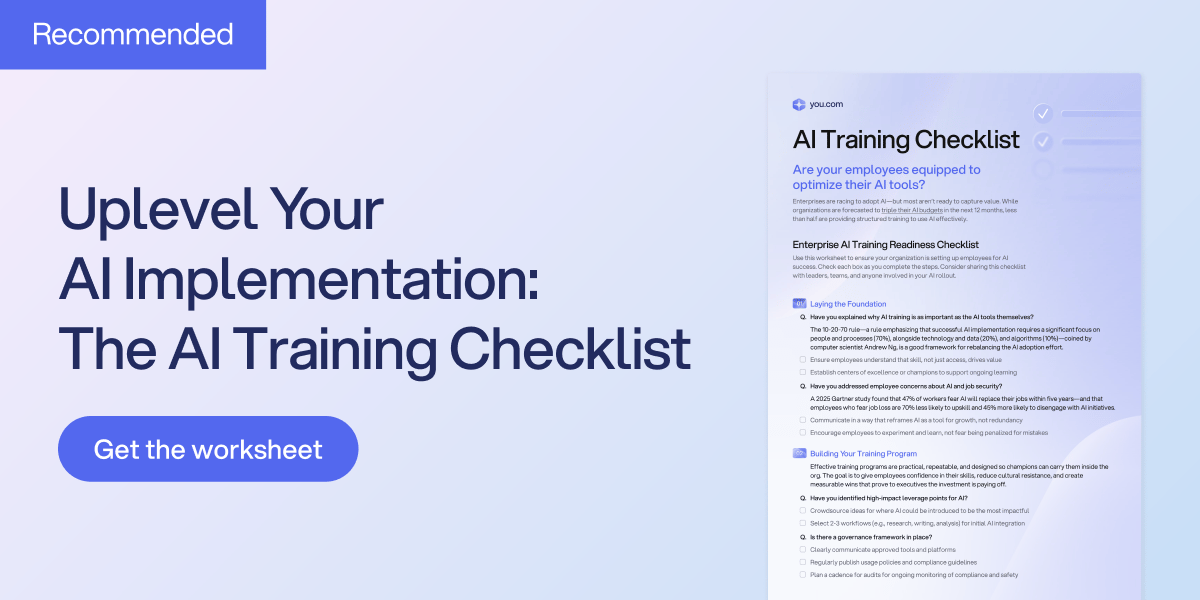
One of the biggest reasons AI adoption stalls is because teams aren’t properly trained. This AI Training Checklist from You.com highlights common pitfalls and guides you to build a capable, confident team that can make the most out of your AI investment. Set your AI initiatives on the right track.
*Ad