- AI Business Insights
- Posts
- Spreadsheets Just Got Vibe-Coded
Spreadsheets Just Got Vibe-Coded
You’re Not Ready for This
We are rapidly approaching a reality where software is no longer something you buy off the shelf, but something you conjure into existence during a coffee break.
The era of rigid, one-size-fits-all applications is fading, replaced by hyper-customized tools built on the fly. I recently stumbled upon a fascinating experiment by an innovative AI professional who demonstrated this shift perfectly.
In partnership with

Missed OpenAI? The Clock Is Ticking on RAD Intel’s Round

Ground floor opportunity on predictive AI for ROI-based content.
RAD Intel is already trusted by a who’s-who of Fortune 1000 brands and leading global agencies with recurring seven-figure partnerships in place.
$50M+ raised. 10,000+ investors. Valuation up 4,900% in four years*.
Backed by Adobe and insiders from Google. Invest now.
This is a paid advertisement for RAD Intel made pursuant to Regulation A+ offering and involves risk, including the possible loss of principal. The valuation is set by the Company and there is currently no public market for the Company's Common Stock. Nasdaq ticker “RADI” has been reserved by RAD Intel and any potential listing is subject to future regulatory approval and market conditions. Investor references reflect factual individual or institutional participation and do not imply endorsement or sponsorship by the referenced companies. Please read the offering circular and related risks at invest.radintel.ai.
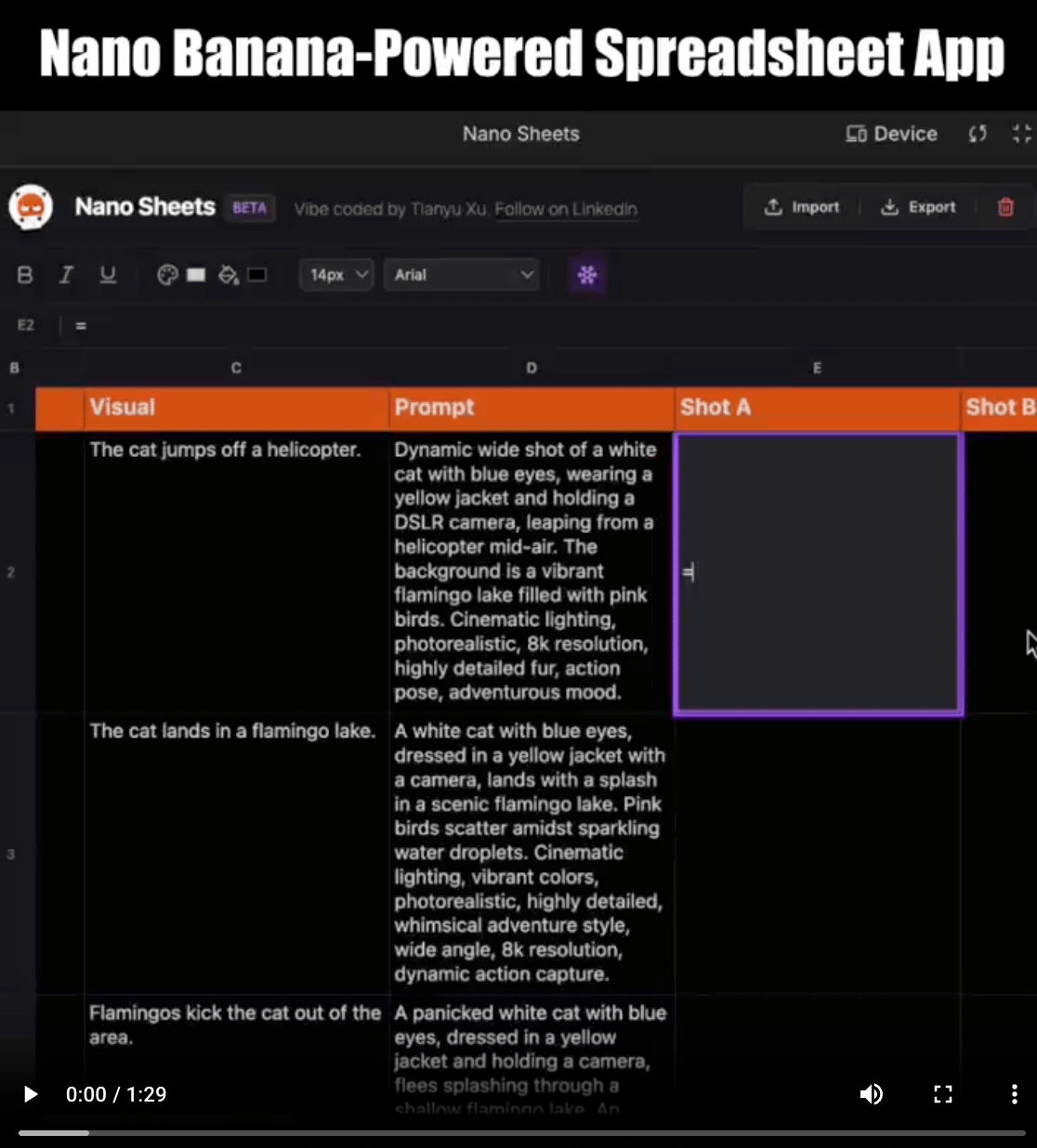
The concept is called “vibe coding,” and it represents a massive departure from traditional programming or software procurement. The author of this post didn’t wait for Microsoft or Google to release a specific feature set; instead, they used Google AI Studio to build a bespoke online spreadsheet application from scratch in just two hours.
This wasn’t a simple script running on top of existing software, but a standalone prototype powered by Gemini 3 Pro and a model referred to as Nano Banana. The goal was to see if a functional, AI-native spreadsheet could be created to solve specific creative problems without the bloat of enterprise software.
The Mechanics of the Vibe-Coded Spreadsheet
At its core, this project challenges the definition of what a spreadsheet should be. Traditional sheets are grids for numbers and static text, but this creator designed a workspace that treats generative AI as a native data type. By leveraging Gemini 3 Pro, the application understands context and intent within the cells.
The genius here lies in the integration. The expert didn’t just hook up an API; they created a user interface that feels familiar but behaves magically. The application allows users to call upon advanced language and image models directly within the grid structure using simple, Excel-like syntax.
This means the friction between data entry, content generation, and asset creation is completely removed. It transforms the spreadsheet from a place where you store data into a place where you create it.
Text Automation Beyond Basic Formulas
The first major breakthrough in this prototype is how it handles textual data. Standard spreadsheets rely on rigid formulas like VLOOKUP or CONCATENATE, which require structured data to work effectively. This innovator introduced a suite of natural language functions that operate on meaning rather than just syntax.
For example, the function =AI(“prompt”, cell_or_range) acts as a universal adapter. You aren’t limited to pre-programmed logic; you can ask the cell to summarize, analyze sentiment, or extract specific entities from a block of text. Furthermore, the inclusion of specific utility functions like =PROOFREAD(cell) and =SHORTEN(“word_count”, cell) shows a deep understanding of actual workflow bottlenecks. Instead of copying text out to a grammar checker or a summarizer and then pasting it back, the logic happens right where the data lives. For content marketers or project managers, this capability alone saves hours of context switching.
Multimodal Creativity in the Grid
What truly sets this project apart is the integration of image generation directly into the cell architecture. The author demonstrated this by uploading a half-completed storyboard template. Usually, storyboarding involves a disjointed workflow: writing prompts in a document, generating images in a separate tool like Midjourney, and then pasting them into a slide deck or sheet.
In this vibe-coded app, the creator utilized functions like =IMAGINE(cell_with_prompt) and =CHANGE(“prompt”, image_cell) to generate and edit visuals using the Nano Banana model without leaving the tab. This allows for an iterative creative process where text prompts and resulting images sit side-by-side. If the image isn’t right, you tweak the prompt in column A, and the image in column B updates instantly. This multimodal approach turns the spreadsheet into a dynamic canvas for visual storytelling.
Shoppers are adding to cart for the holidays

Over the next year, Roku predicts that 100% of the streaming audience will see ads. For growth marketers in 2026, CTV will remain an important “safe space” as AI creates widespread disruption in the search and social channels. Plus, easier access to self-serve CTV ad buying tools and targeting options will lead to a surge in locally-targeted streaming campaigns.
Read our guide to find out why growth marketers should make sure CTV is part of their 2026 media mix.
*Ad
Other awesome AI guides you may enjoy
The Philosophy of Vibe Coding
The most significant takeaway from this post isn’t the software itself, but the philosophy behind it. “Vibe coding” is about capturing a fleeting idea and materializing it immediately to tackle a specific challenge. The creator emphasizes that this isn’t about copying what is already on the market or trying to build a competitor to Excel.
It is about bringing “crazy ideas” to life to solve niche problems that big tech companies will never address. If you need a tool that specifically translates, shortens, and generates storyboard images, you build it. This suggests a future where we move away from monolithic apps toward disposable, purpose-built micro-apps tailored to the specific “vibe” or requirement of a project. It empowers individuals to become the architects of their own digital environments.
The Function Toolbox
=AI(“prompt”, cell_or_range): An all-purpose generative function for unrestricted tasks.
=TRANSLATE(“lang”, cell): Instantly converts text into the target language.
=PROOFREAD(cell): automatically corrects grammar and spelling errors.
=SHORTEN(“word_count”, cell): Condenses text to a specific length constraint.
=IMAGINE(cell_with_prompt): Creates visual assets from text descriptions.
=CHANGE(“prompt”, image_cell): Edits existing images based on new instructions.
This experiment offers a glimpse into 2026, where the line between user and developer blurrs into oblivion.
I highly recommend looking at the original post to see the storyboard demo in action; it is a masterclass in rapid prototyping!
Voice AI: Get the Proof. Avoid the Hype.
Deepgram interviewed 400 senior leaders on voice AI adoption: 97% already use it, 84% will increase budgets, yet only 21% are very satisfied with legacy agents. See where enterprises deploy human-like voice AI agents - customer service, task automation, order capture. Benchmark your roadmap against $100M peers for 2026 priorities.
*Ad