- AI Business Insights
- Posts
- Optimize Your Brand for AI Search
Optimize Your Brand for AI Search
Your Brand vs Ruthless Algorithms
AI search engines aren’t just finding content anymore; they are actively deciding whether to recommend your brand or pretend it doesn’t exist.
If the algorithm doesn’t “like” your digital footprint, you remain invisible regardless of your content quality. I just saw this incredible post from an AI professional who broke down exactly how to optimize your brand for this new reality.
In partnership with

Shoppers are adding to cart for the holidays

Over the next year, Roku predicts that 100% of the streaming audience will see ads. For growth marketers in 2026, CTV will remain an important “safe space” as AI creates widespread disruption in the search and social channels. Plus, easier access to self-serve CTV ad buying tools and targeting options will lead to a surge in locally-targeted streaming campaigns.
Read our guide to find out why growth marketers should make sure CTV is part of their 2026 media mix.
The New SEO: Data First, AI Second
The core philosophy shared by the expert is that while we all use AI, using it without a data foundation is just guessing. She explains that to truly optimize for the new search landscape, you have to manage three specific relationships with the AI models: making them love your content, making them trust your brand, and ensuring they don’t “hate” (or reject) your technical setup.
To achieve this, the original poster utilizes a combination of Semrush One for data gathering and tools like Perplexity, Gemini, and NotebookLM for execution. The goal isn’t just to rank; it’s to train the AI to see your brand as the most probable, authoritative answer to a user’s prompt. Here is the deep dive into the three relationships she outlined.
Relationship 1: Make AI Love Your Content
This phase is about relevance. The creator points out a strong correlation between traditional Google rankings and AI citations. If you aren’t relevant in traditional search, the AI is unlikely to cite you. She details a fascinating workflow to fix this:
The Competitor Gap Analysis: Instead of just looking at your own keywords, the author suggests running a “Keyword Gap” analysis against competitors who offer similar products. This reveals where search engines already associate your competitors with a niche, but not you. She recommends filtering for keywords ranked on page 2 or 3: these are your high-potential targets.
The Perplexity Audit: This was a brilliant move. The expert takes that list of potential keywords and uploads it to Perplexity (or another agentic AI browser). She asks the AI to review the search results for those terms and identify exactly why the top pages are ranking. The output is a specific content optimization checklist based on what the AI currently favors.
Targeting Questions, Not Just Keywords: AI search is semantic. The video demonstrates using “Prompt Research” to find the actual questions users are asking AI, not just the keywords they type into Google. By analyzing the sources AI cites for these questions, you can reverse-engineer the perfect answer.
The NotebookLM Workflow: The innovator uses NotebookLM to digest the top-performing competitor URLs. She asks it to generate custom instructions for writing a blog post that beats the current sources. This ensures the new content is structurally and thematically aligned with what the AI already “loves.”
Relationship 2: Make AI Trust Your Brand
AI doesn’t just read text; it validates authority. The expert emphasizes that before an AI recommends you, it checks your reputation across the web. If you lack “off-site” signals, you aren’t trusted.
Share of Voice & Sentiment: The author uses a “Brand Performance” tool to track how AI perceives the brand’s share of voice compared to competitors. This reveals whether the AI sees you as a market leader or a minor player.
Identifying Narrative Drivers: This is crucial. The savvy professional looks for “narrative drivers”: specific questions where competitors are being cited. By filtering for questions where you don’t rank, you find the exact gaps in your authority.
Reverse-Engineering Citations: The creator shows how to see exactly which domains are citing your competitors. It’s often not just blogs; it’s Reddit threads, LinkedIn posts, and YouTube videos. These are the sources the AI trusts.
The Outreach Strategy: Once these sources are identified (e.g., a specific Reddit thread or industry blog), she exports the list to Gemini. She asks Gemini to prioritize them based on brand fit. The advice here is excellent: don’t just ask for a link. Offer unique data or an expert quote to update their existing content. This updates the “freshness” signal, which AI loves.
Visual Authority: A really cool tip she added was asking NotebookLM (powered by the new multimodal models) to generate decision flowcharts or infographics based on the content. This adds a layer of visual authority that many competitors miss.
AI-native CRM

“When I first opened Attio, I instantly got the feeling this was the next generation of CRM.”
— Margaret Shen, Head of GTM at Modal
Attio is the AI-native CRM for modern teams. With automatic enrichment, call intelligence, AI agents, flexible workflows and more, Attio works for any business and only takes minutes to set up.
Join industry leaders like Granola, Taskrabbit, Flatfile and more.
*Ad
Other awesome AI guides you may enjoy

Relationship 3: Make AI Not Hate Your Site
This is the technical foundation. You can have the best content in the world, but if the AI bots physically cannot access or understand your site, you are dead in the water. The expert calls this “making AI not hate you.”
The Crawlability Check: The first thing she checks is the
robots.txtfile. Many sites accidentally block new AI bots (likeGoogleOtheror specific Gemini bots) while allowing traditional Google bots. If you block the AI bot, you will never be cited in an AI overview.Structure Depth: The author argues for a “flat” site architecture. She explains that AI indexing is resource-intensive. If your content is buried five clicks deep (a crawl depth of >3), the AI might give up before it finds it. Keeping important content within 1-3 clicks of the homepage is vital for AI discovery.
Schema Markup: This is the language of machines. The video highlights the importance of structured data (Schema) for things like FAQs, products, and organizations. This code helps the AI instantly identify entities without having to “guess” what the page is about. If your competitor has clear Schema and you don’t, the AI is more likely to pull data from them because it’s computationally easier.
This approach shifts SEO from a keyword game to a reputation management game. It’s about ensuring the AI understands who you are, trusts your authority, and can easily access your data.
For the full visual walkthrough and to see the specific prompts used in the tools, check out the original video.
When training takes a backseat, your AI programs don't stand a chance.
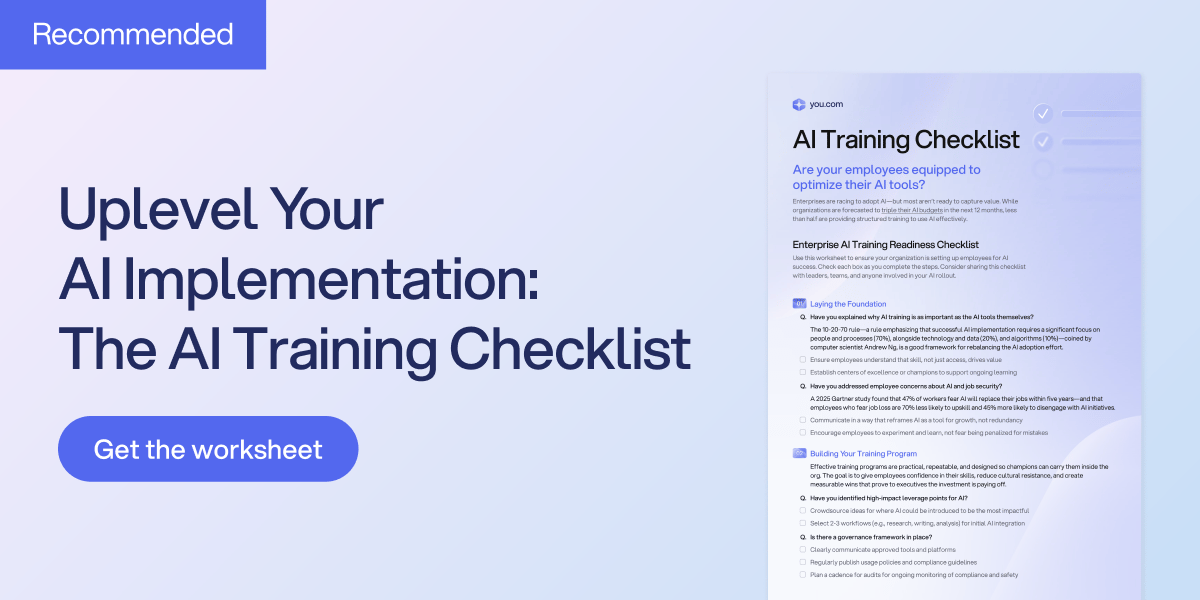
One of the biggest reasons AI adoption stalls is because teams aren’t properly trained. This AI Training Checklist from You.com highlights common pitfalls and guides you to build a capable, confident team that can make the most out of your AI investment. Set your AI initiatives on the right track.
*Ad