- AI Business Insights
- Posts
- Master AI to Become Irreplaceable
Master AI to Become Irreplaceable
One Question, Instant Leverage
Last spring, I sat in a meeting where one person quietly ran the room. Not because they talked the most, but because they got results faster than everyone else. They would ask one clear question, feed it to an AI tool, and come back with a draft, a plan, and three options before the rest of us finished debating. That moment hit me hard. The “average vs. essential” gap is not talent anymore, it is tool fluency. I recently dug into a breakdown from this LinkedIn creator who lays out a simple path to cross that gap by building specific AI skills.
The shift is bigger than learning a clever shortcut. It is a change in how you think about work. The creator argues that by 2026, the real divide will be between people who manually execute tasks and people who direct AI to execute them.
That requires a mindset flip. Stop treating AI like a cheat code and start treating it like an instrument. Instruments reward practice, not hype.

Want to get the most out of ChatGPT?
ChatGPT is a superpower if you know how to use it correctly.
Discover how HubSpot's guide to AI can elevate both your productivity and creativity to get more things done.
Learn to automate tasks, enhance decision-making, and foster innovation with the power of AI.
*Ad
The mechanism is a structured learning plan that favors hands-on projects over pure theory. You do small builds, you ship, you break things, you fix them. The goal is to future-proof your career by becoming the pilot, not the passenger.
Commanding the Creative Stack
The first pillar is learning to produce media at a level that used to require a whole team. Prompt engineering is the base layer, but the value shows up when you apply it to visual and video creation.
We are heading into a world where one person can generate strong assets for social posts, blogs, newsletters, landing pages, and even offline ads. Not “pretty AI art,” but usable creative that matches a message and a goal. When you can go from idea to finished assets quickly, you become the person who can execute, not just brainstorm.
To make this real, practice with constraints. Pick one product, one audience, one style, and create a full set of assets for a campaign in a weekend. You will learn more from that than from ten threads about “the best prompts.”
Democratizing Development
The second pillar is building things, even if you do not have a computer science background. The creator highlights AI coding, website development, and app development as skills that are becoming practical for non-engineers.
The point is not that AI replaces developers. The point is that it turns you into a faster builder who can prototype ideas, test them, and iterate without waiting weeks. Tools like Claude Code or other coding assistants can help you move from “I wish this existed” to “here is a working version.”
If you want leverage, focus on MVP habits. Ship a tiny version, collect feedback, fix the top two problems, repeat. That loop is what separates people who “learn AI” from people who create value with it.
The Age of Agents and Automation
The third pillar is automation and agent development, the “set it and forget it” layer. This is not just making a chatbot that answers FAQs. It is designing systems that handle repeatable workflows across apps.
Think of agents as reliable helpers with a job description. One agent qualifies leads, another drafts follow-ups, another updates your CRM, another monitors a metric and alerts you when something changes. When you connect tools together into a smooth pipeline, you become the architect of efficiency, and that efficiency works while you sleep.
A practical place to start is one annoying workflow you do every week. Map it in five steps, automate step one, then step two. Small automations compound fast.
Other awesome AI guides you may enjoy
The catch most people ignore
It is easy to get swept up by the power of these tools. The creator’s warning is important: do not skip the foundations just to play with advanced features.
If you let AI do the thinking, you will not know what to do when it breaks, hallucinates, or quietly makes a bad assumption. You need basic logic and reasoning to debug outcomes, plus an understanding of ethics, bias, and privacy so you do not create problems you cannot see until it is too late.
Real expertise is the mix of strong tools and strong judgment. Ask better questions, verify outputs, and stay curious when you get stuck.
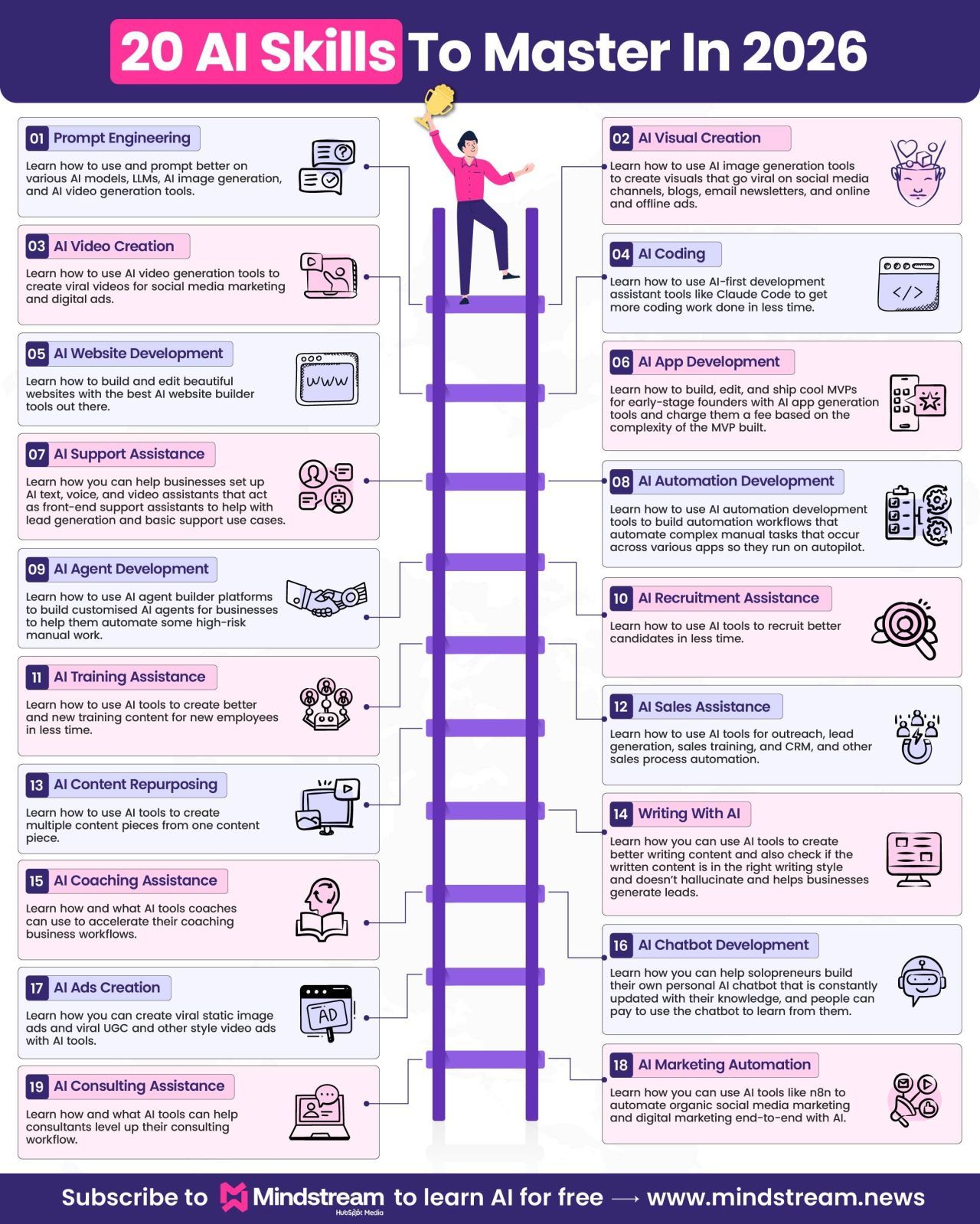
Credits to Adam Biddlecombe