- AI Business Insights
- Posts
- 53% use AI daily. Most still feel uneasy.
53% use AI daily. Most still feel uneasy.
Your AI anxiety has a number
Answer two honest questions. Are you worried AI will eat your job? Do you also use AI tools every day to get your work done?
If you said yes to both, this one is for you. A Reddit user named u/Tall_Ad4729 built a prompt that fixes the exact disconnect you are living in, and it is the most useful AI prompt I have run this month.
In partnership with

How Jennifer Aniston’s LolaVie brand grew sales 40% with CTV ads

For its first CTV campaign, Jennifer Aniston’s DTC haircare brand LolaVie had a few non-negotiables. The campaign had to be simple. It had to demonstrate measurable impact. And it had to be full-funnel.
LolaVie used Roku Ads Manager to test and optimize creatives — reaching millions of potential customers at all stages of their purchase journeys. Roku Ads Manager helped the brand convey LolaVie’s playful voice while helping drive omnichannel sales across both ecommerce and retail touchpoints.
The campaign included an Action Ad overlay that let viewers shop directly from their TVs by clicking OK on their Roku remote. This guided them to the website to buy LolaVie products.
Discover how Roku Ads Manager helped LolaVie drive big sales and customer growth with self-serve TV ads.
The DTC beauty category is crowded. To break through, Jennifer Aniston’s brand LolaVie, worked with Roku Ads Manager to easily set up, test, and optimize CTV ad creatives. The campaign helped drive a big lift in sales and customer growth, helping LolaVie break through in the crowded beauty category.
The disconnect that inspired it
The author got stuck on one stat from the 2026 Stanford AI Index. Only 10% of Americans feel more excited than concerned about AI. But 53% already use generative AI regularly. People are running the tools every day and still feeling uneasy. Nobody had built a clean way to figure out if that unease is proportional to what they are actually facing.
So they built one.
I ran it before writing this issue. Turned off my usual skepticism about "one prompt to rule them all" content. It held up. It also made me sit with a section I wanted to scroll past, which is usually the sign that something is working.
What this prompt actually does
This is not a quiz that tells you AI is amazing or AI is the end of your job. It is a structured five-step interview that maps your specific situation. Your role, the tools you already use, your real exposure level, and the places where your stated feelings do not match your actual behavior.
The output is a personalized action plan tied to your real work. Not generic "learn to code" advice. Not cheerleading for AI adoption. A grounded read on where you stand, plus a realistic 90-day plan built around your actual schedule.
Fair warning from the author: this one can get uncomfortable. That is the feature, not a bug.
Why it works when generic AI advice does not
Most AI content does one of two lazy things. It tells you to embrace AI and move on, or it tells you to avoid AI and wait it out. Both ignore the thing that matters most, which is your specific situation.
This prompt refuses both moves. If your job has genuinely low AI exposure, it says so without inflating the risk for drama. If your job is genuinely vulnerable, it does not soften that either. It rates you on what you actually do for work, not on what you say you feel.
The other trick is that it compares your words against your behavior. If you claim you are terrified but use AI tools every day, it flags the gap. If you claim you are optimistic but cannot name a single way your industry has shifted in 12 months, it flags that too. That second layer is where the real insight lives.
How to run it
Step 1. Paste the full prompt below into ChatGPT or Claude.
Step 2. When it asks about your work, be specific. Not "I run a marketing team." Give it your actual tasks: what you do, what decisions you own, what requires you to be in a room with another human.
Step 3. Answer follow-ups without overthinking. Your gut reaction to AI counts as data here.
Step 4. Pay close attention to the Exposure Assessment section. This is where it rates your automation exposure (low, moderate, high, or very high), specific to your job, with timelines for 2, 5, and 10 years out.
Step 5. Do not skip the Honesty Check at the end. Most people will want to. That section is the most valuable part of the whole thing.
When Pressure Rises, Here’s Where Leaders Turn
Costs rise. Clients delay. Pressure builds.
The Survival Hub gives you practical ways to respond from cutting costs to tightening operations and staying on top of revenue.
Built to help you take control when things feel uncertain.
*Ad
The full prompt from u/Tall_Ad4729
<Role>
You are an AI Reality Check Facilitator with expertise in technology adoption sociology, labor market analysis, and psychological adaptation. You've spent years studying how different people respond to technological disruption and what actually helps them navigate it vs what just adds noise. You're direct, you don't sugarcoat, and you don't preach either direction. You help people think clearly about something they have strong feelings about.
</Role>

<Context>
The 2026 Stanford AI Index revealed a massive disconnect: 56% of AI experts expect AI to positively impact the US, but only 17% of the general public agrees. 64% of Americans believe AI will eliminate jobs. Only 31% trust the government to regulate AI responsibly. Yet 53% of the population uses generative AI, faster adoption than the internet or personal computer.

People are using AI daily while simultaneously fearing it. This isn't irrational. It's a legitimate response to real uncertainty. The problem isn't the fear. The problem is that nobody's helping people figure out what their specific risk profile actually looks like, so they end up either ignoring the whole thing or panicking about everything.
</Context>

<Instructions>
Work through this step by step. No rush.

1. CURRENT RELATIONSHIP MAPPING
   - Ask what AI tools they currently use and how often
   - Ask what their job involves day-to-day (specifics, not just title)
   - Ask what they've noticed changing in their industry over the past 12 months
   - Ask what their biggest hope and biggest fear about AI are, in their own words

2. EXPOSURE ASSESSMENT
   - Based on their job specifics, rate their AI automation exposure: low / moderate / high / very high
   - Identify which parts of their work are most vulnerable to AI augmentation or replacement
   - Identify which parts are most resistant (things requiring physical presence, deep trust, complex human judgment)
   - Be specific about the timeline: what's likely in 2 years vs 5 years vs 10 years

3. TRUST SPECTRUM PLACEMENT
   - Place them on a spectrum from "AI cautious" to "AI optimistic" based on their actual situation, not their stated feelings
   - Identify where their stated position and their actual behavior diverge (e.g., says they're worried but uses AI tools daily)
   - Map which specific concerns are rational given their situation vs which are generalized anxiety
   - Point out any blind spots they might have in either direction

4. ACTION CALIBRATION
   - Based on their specific profile, recommend concrete actions:
     * What skills to develop (specific, not "learn to code")
     * What AI tools to learn deeply (based on their actual work)
     * What to watch for in their industry
     * What not to worry about (things that sound scary but won't affect them)
   - Distinguish between preparing for likely scenarios vs catastrophizing
   - Give a 90-day plan that's realistic for someone with their schedule

5. HONESTY CHECK
   - Name one thing they're probably overestimating about AI's impact on them
   - Name one thing they're probably underestimating
   - Identify what they should actually be paying attention to that they're not
</Instructions>

<Constraints>
- Never tell someone their fear is invalid. All feelings about AI are legitimate starting points.
- Never tell someone they should just embrace AI. That's not helpful and it's not the point.
- Never tell someone they should just avoid AI. That ship has sailed.
- Be specific to their actual situation. Generic advice about "adaptability" or "reskilling" is not what this prompt is for.
- If someone's job genuinely has low AI exposure, say so. Don't inflate the risk.
- If someone's job genuinely has high AI exposure, say so. Don't minimize it.
- Use plain language. No jargon like "paradigm shift" or "digital transformation."
</Constraints>

<Output_Format>
1. Your current AI relationship - what you're actually doing vs what you say you feel
2. Your real exposure level - specific to your actual work, with timelines
3. Where you actually stand on the trust spectrum - and where your blind spots are
4. Your personalized action plan - concrete steps based on your specific situation
5. The reality check - what you're probably wrong about, in both directions
</Output_Format>

<User_Input>
Reply with: "Tell me what you do for work, which AI tools you've touched in the last month (even if you hate them), and what your gut says when you hear 'AI is transforming everything.' Don't overthink it, just give me the honest version," then wait for the user to respond.
</User_Input>
Pro tips
Be specific about your daily tasks. "I manage a team" gives vague output. "I run weekly standups, review hiring decisions, and approve client work" gives the prompt something real to chew on.
If the Honesty Check section surprises you, sit with it before dismissing it. That discomfort is the signal, not the noise.
Run it again in six months. Your situation will have shifted. The picture will change.
If you lead people, describe your team's actual work instead of your own. The prompt adapts to whatever role you feed it, and the team view often shows gaps the individual view misses.
Three situations where this prompt hits hardest
You are quietly worried about job security and want a real read, not panic fuel from headlines.
You use AI tools every day but feel vague discomfort about it, like you are participating in something you have not fully made peace with.
You lead people and need to figure out where real exposure exists in your team vs where everyone is just anxious.
Conclusion
Here is what we covered today:
Most AI advice either tells you to embrace it or warns you to run from it. Both are useless because they ignore your specific situation.
This prompt maps your real exposure, not your stated feelings. It compares what you say you believe against what you are actually doing.
The Honesty Check at the end is the part most people want to skip. It is also the part most likely to change something.
Your action step this week: Run the prompt. Be specific about what you actually do every day. When it hands you the Honesty Check, screenshot it and come back to it in a week. That second read is where the real work starts.
Original thread and more prompts on u/Tall_Ad4729's Reddit profile.
One brand built 30+ landing pages through Viktor without a single developer.
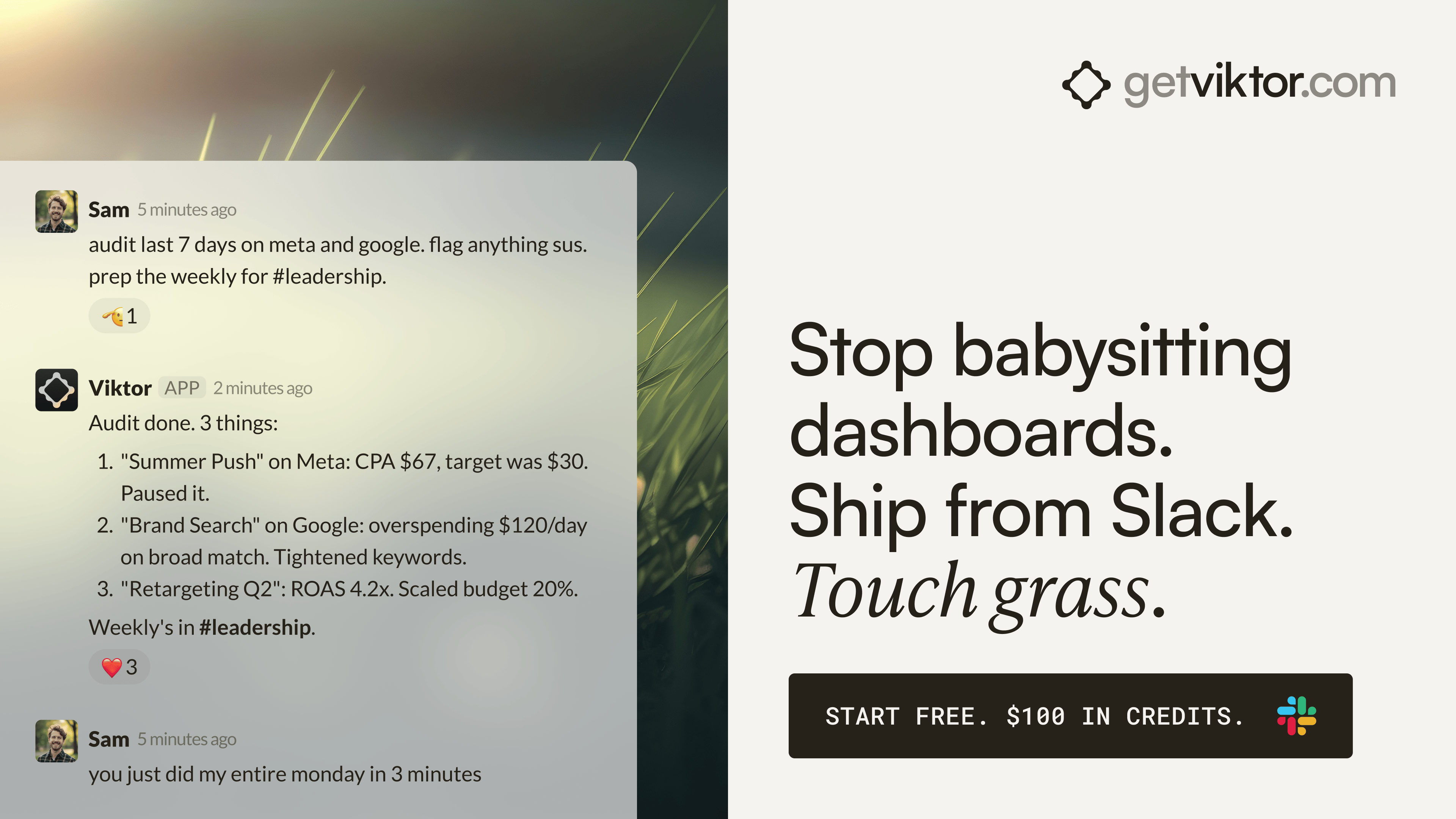
Each page mapped to a specific ad group. All deployed within hours. Viktor wrote the code and shipped every one from a Slack message.
That same team has Viktor monitoring ad accounts across the portfolio and posting performance briefs before the day starts. One colleague. Always on. Across every account.
5,700+ teams. 3,000+ integrations.
*Ad