- AI Business Insights
- Posts
- 30 Prompts to End Decision Paralysis
30 Prompts to End Decision Paralysis
Turn Chaos into a Plan
I’ve watched smart, hardworking leaders freeze at the exact moment they need to move. Not because they’re weak. Not because they’re “not CEO material.” But because decision-making is the one skill you can’t outsource, and the pressure makes your brain lie to you. You start spinning stories, not evaluating facts. And suddenly a simple choice becomes a foggy, emotional mess.
That’s why this talented AI professional’s post grabbed me. They make a blunt point: great leadership isn’t about having magical instincts or absurd luck. It’s about using a cleaner framework when the stakes feel personal. Their “secret weapon” is a set of ChatGPT prompts that treat the model like an objective, unemotional consultant, not a replacement for your brain.

Want to get the most out of ChatGPT?
ChatGPT is a superpower if you know how to use it correctly.
Discover how HubSpot's guide to AI can elevate both your productivity and creativity to get more things done.
Learn to automate tasks, enhance decision-making, and foster innovation with the power of AI.
*Ad
The philosophy is refreshing. You do not hand the wheel to AI. You hand it the messy situation, the constraints, the fears you’re trying not to admit, and you ask it to structure the problem. Done right, it turns anxiety into categories, trade-offs, and next steps you can actually defend.
Strategic Evaluation Matrices
The first big takeaway is weighted decision matrices for business decisions. Most of us “evaluate” options by replaying the same two thoughts in our head and calling it analysis. This creator suggests forcing the choice into a table, with explicit metrics and weights, so your gut doesn’t quietly move the goalposts.
Use this prompt to make the trade-offs visible:
“I am deciding between [Option A], [Option B], and [Option C] for my business. Provide a structured decision matrix where you track each option against evaluation metrics such as long-term ROI, alignment, risks, and feasibility. Assign weights to each factor, rank for each score, and end with a scenario recommendation of the best choice along with possible trade-offs.”
A small upgrade that makes this even stronger: define what a “10” means for each metric before scoring. Otherwise, you will still game the system without realizing it.
Career and Value Alignment
The next angle is career decisions, but with a twist that most pros-and-cons lists miss. People obsess over salary and title because those are easy to compare. Values are harder, so they get ignored, until you’re six months into a job that looks great on paper and feels wrong every morning.
This prompt adds that missing layer by asking for skills, stability, and fit. It pushes you to name your values instead of pretending you’ll “figure it out later.”
“I’m torn between pursuing [Career Path A] and [Career Path B]. Analyse both paths in terms of salary potential, required skills, long-term growth opportunities, and career stability. For each option note risks and rewards, highlight career paths made by others with similar roles, and decide which one is the best fit for my values [insert personal values].”
If you want the answer to feel more real, add one line: “Assume I’m risk-averse” or “Assume I get bored easily.” The model cannot read your mind, so you have to feed it your truth.
Resource and Time Optimization
The final insight is about the finite resources you cannot print more of: time and energy. Most schedules fail because they’re built for an imaginary version of you who never gets tired. The prompt here is smart because it demands rest and sustainability, not just productivity theater.
Try this for a balanced plan:
“I have [X hours] available per day and need to allocate them between [Activity A], [Activity B], and [Activity C]. Optimise the schedule with balances in effectiveness, rest, and long-term productivity. Recommend the best time allocation plan with practical proof and examples, and create a framework based on a sample day plan.”
One extra move: ask it to identify the single “keystone hour” of your day, the one hour that makes the rest easier. That’s where the leverage lives.
Other awesome AI guides you may enjoy
The Human Element
The best part is how the original LinkedIn user closes it out. AI can map the logic fast and expose blind spots, but it cannot feel the consequences. You still have to own the call, and sometimes your intuition is data you haven’t learned to explain yet.
The original post contains a full infographic with dozens more prompts covering various other scenarios.
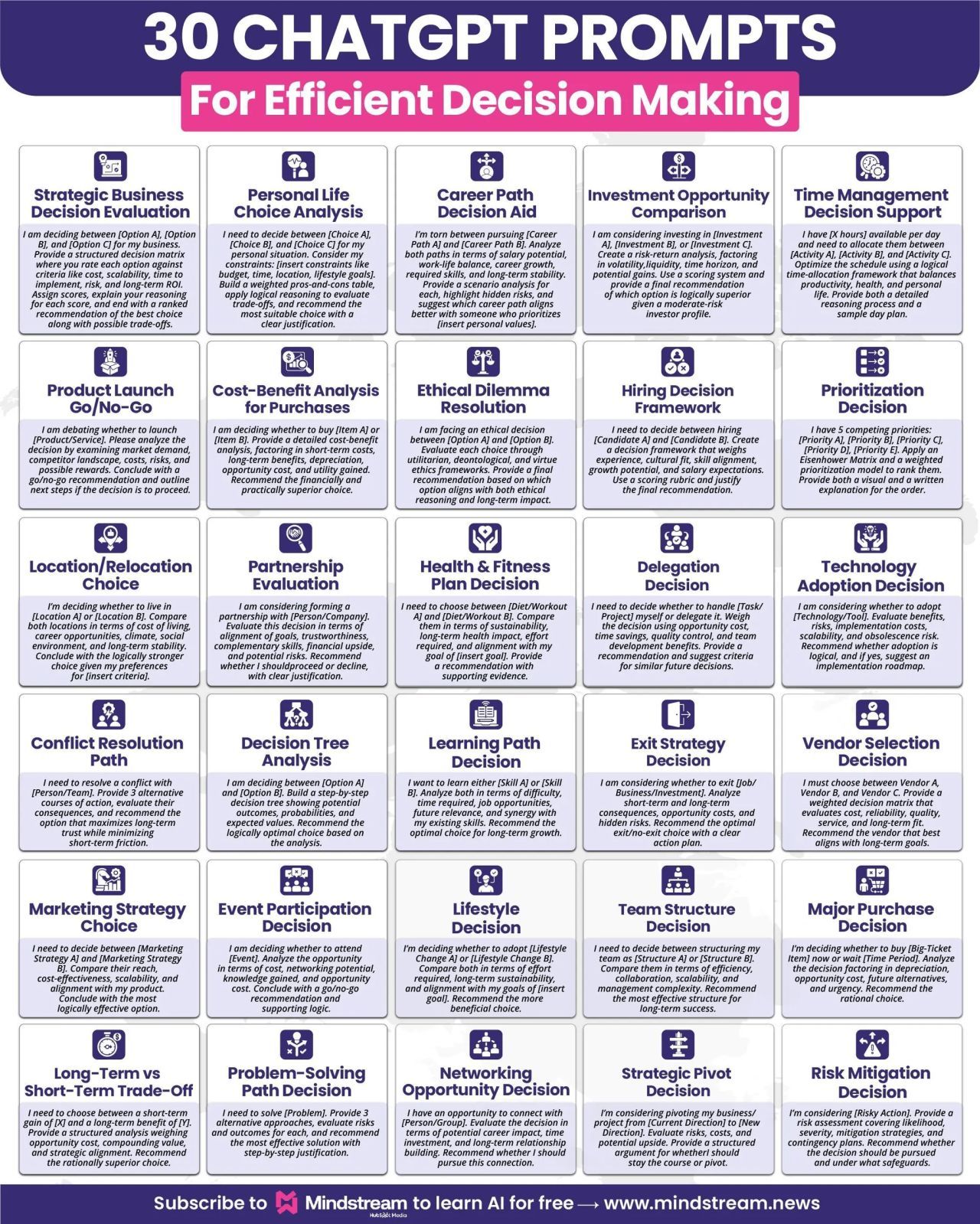
Credits to Adam Biddlecombe